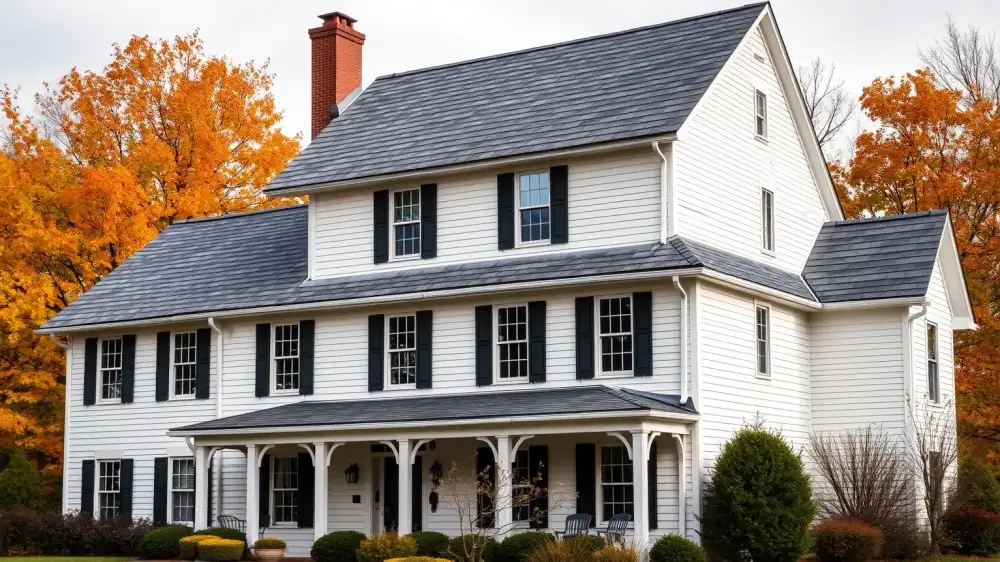
What Roof Repair Includes
A repair starts with a roof inspection — walking the pitch, checking valleys, pipe boots, and chimney flashing, then photographing every defect.
You get a written scope of work and a roof estimate before anyone climbs back up.
- Tear-out of failed material down to sound decking
- Replacement of felt or synthetic underlayment where compromised
- New ice-and-water shield at eaves and valleys
- Step flashing, counter-flashing, and pipe flashing reset or replaced
- Sealant, mastic, and roof cement at terminations
- Magnetic sweep for nails, plus dumpster and debris haul-off
Quality & Materials Standards
Material choice follows the substrate, not a sales pitch.
Architectural shingle and dimensional laminated products suit most pitched roofs here, while three-tab shingle remains a budget option with a shorter service life.
On steeper custom homes, concrete tile, clay tile, and standing-seam panel handle heat and hail far better than asphalt.
Work must meet local building code, including ventilation balance.
A ridge vent paired with adequate soffit vent keeps attic heat from cooking the sheathing and shortening membrane life.
Ice-and-water shield belongs at every eave and valley regardless of our mild winters.
Insurance vocabulary matters when storm damage hits. A claim typically needs claim documentation, an adjuster inspection, and a proof of loss.
Know your deductible, understand depreciation versus replacement cost, and expect a supplement if hidden damage appears once tear-off begins.
Never accept a scope of work that skips mitigation.
Local Service Areas
Fountain Hills Downtown
Older in-town homes near Fountain Park mix tile and asphalt roofs on tighter lots.
- 1980s–1990s stucco homes with original underlayment now brittle
- Flat and low-slope sections showing ponding water at drains
- Gutter and downspout overflow staining fascia along the roofline
- Valley flashing corroded from years of monsoon runoff
Fountain Hills East
A dense pocket of 1990s–2000s tract construction where roofs age in clusters.
- Three-tab shingle losing granules after repeated UV degradation
- Blown ridge cap and lifted drip edge after high-wind events
- Cracked pipe boots and dried caulk at vent penetrations
- Loose fasteners backing out of plywood sheathing
Fountain Hills West
Established homes with a mix of pitched and flat roof assemblies.
- Modified bitumen and built-up roof sections at flat transitions
- Blistering membrane from trapped moisture and heat
- Failing chimney flashing and counter-flashing at masonry
- Sun-cracked sealant along parapet coping
Fountain Hills North
Larger lots and custom builds where long roof runs meet open desert exposure.
- Standing-seam panel and concrete tile over steep gable and hip
- Thermal expansion loosening clamps and seam fasteners
- Wood shake and cedar shake on older custom homes drying and splitting
- Wind-driven hail damage on west-facing planes
The Highlands
Elevated custom desert contemporary homes taking the hardest weather.
- Slate and tile on complex rooflines with multiple valleys and dormers
- Step flashing and apron flashing failures at wall intersections
- Ice dam risk at shaded north eave sections during frost
- Metal panel seam and fastener fatigue from heat cycling
Fountain Hills South
Active adult communities like Sun Ridge and Eagle Mountain with repeat roof types.
- Uniform tract roofs failing on the same schedule
- Membrane and TPO sections on low-slope patio covers
- Skylight and vent boot leaks at aged seals
- Reflective coating worn thin on flat rooftops